
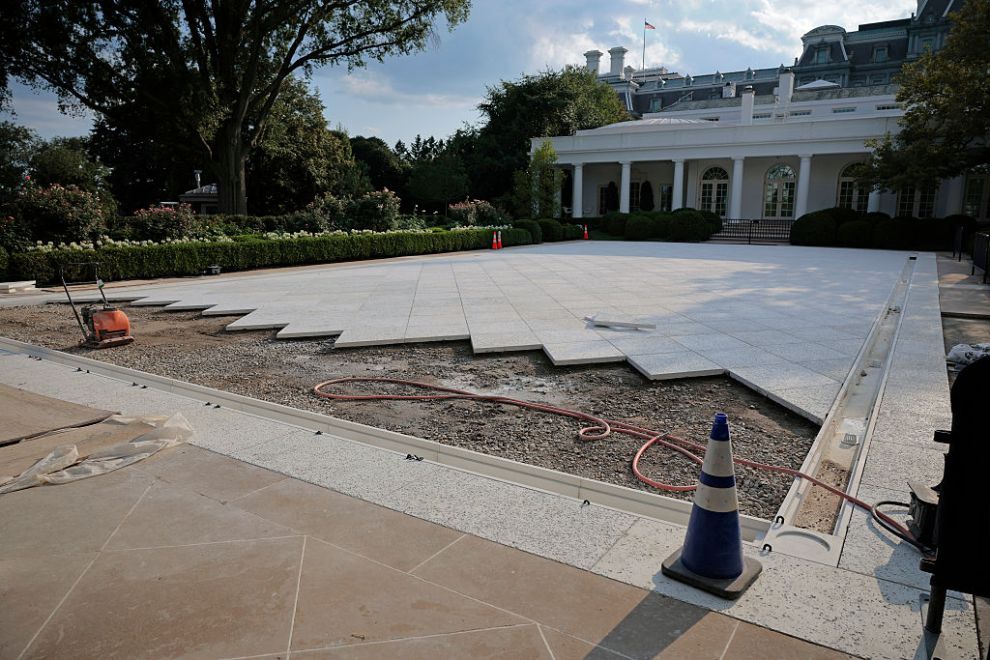
The Rose Garden, one of the most iconic and symbolic spaces at the White House, is in the midst of a substantial renovation under President Trump’s administration. Recent images show a concrete slab replacing much of the lawn, a noticeable shift in a setting long associated with American political tradition. The redesign, expected to be completed by mid-August, has drawn attention not only for its scale but also for what it could signal about the evolving function of the space.
Talks of altering the Rose Garden began shortly after President Trump’s second term began. In early 2025, reports emerged suggesting the President was interested in replacing the traditional grass with a more permanent hardscape—similar to what exists at his Mar-a-Lago estate in Florida. The idea was later confirmed in an interview with The Spectator, where Trump explained his intent to introduce “a stone surface,” which he believes would create a more polished appearance.
“It’s going to be beautiful. I think it will actually look better,” Trump said. “Some people may prefer it as it is, but the issue is you can’t.” He pointed to the challenges posed by rain and soft ground, particularly during press briefings. “The terrain can be wet, and the soft ground can be problematic for some… Women, with high heels, it just didn’t work.”
Preserving Its Core Identity
While the redesign appears sweeping, the President has emphasized that key elements of the garden will remain untouched—namely the roses. “The roses stay. No, it’s a rose garden,” he said, clarifying that the central section of the lawn is the only area undergoing structural changes. The administration’s framing of the project stresses utility and visual clarity while aiming to preserve the garden’s longstanding character.
The current layout of the Rose Garden traces its roots to the Kennedy administration, when landscape designer Rachel “Bunny” Mellon was tasked with creating a formal but inviting space. Mellon drew inspiration from European gardens, shaping the garden in a style that matched President Kennedy’s aesthetic preferences.
A Space with History
Over the decades, the Rose Garden has served as a backdrop for some of the presidency’s most visible moments—state dinners, press conferences, and diplomatic ceremonies. In a recollection of the garden’s origins, Mellon once said, “He wanted to start, in the greatest haste, to remake the area near his office… into an area both useful and attractive.” The result was a blend of elegance and purpose, designed to serve both ceremony and symbolism.
During Trump’s first term, First Lady Melania Trump oversaw a separate refresh of the garden—its first major update in sixty years. That project focused on structural updates and planting changes meant to improve drainage and better accommodate formal gatherings. At the time, the White House described the effort as a move to “restore the garden to its original splendor” while increasing its functionality.
Public and Political Reactions
As renovations progress, reactions have been varied. Some view the redesign as a practical upgrade; others question whether it alters a historic space too drastically. The garden has increasingly become a political flashpoint in recent weeks. A recent proposal from House Republicans to rename a Kennedy Center theater after Melania Trump prompted backlash from Jack Schlossberg, President Kennedy’s grandson. “This isn’t about the arts,” Schlossberg said. “Trump is obsessed with being bigger than JFK.”
The conversation surrounding the Rose Garden’s transformation continues to grow, reflecting a broader tension between legacy and change. Whether the new design enhances the utility of the space or undermines its symbolism remains a question that will likely echo long after the work is complete.
Leave a Reply