
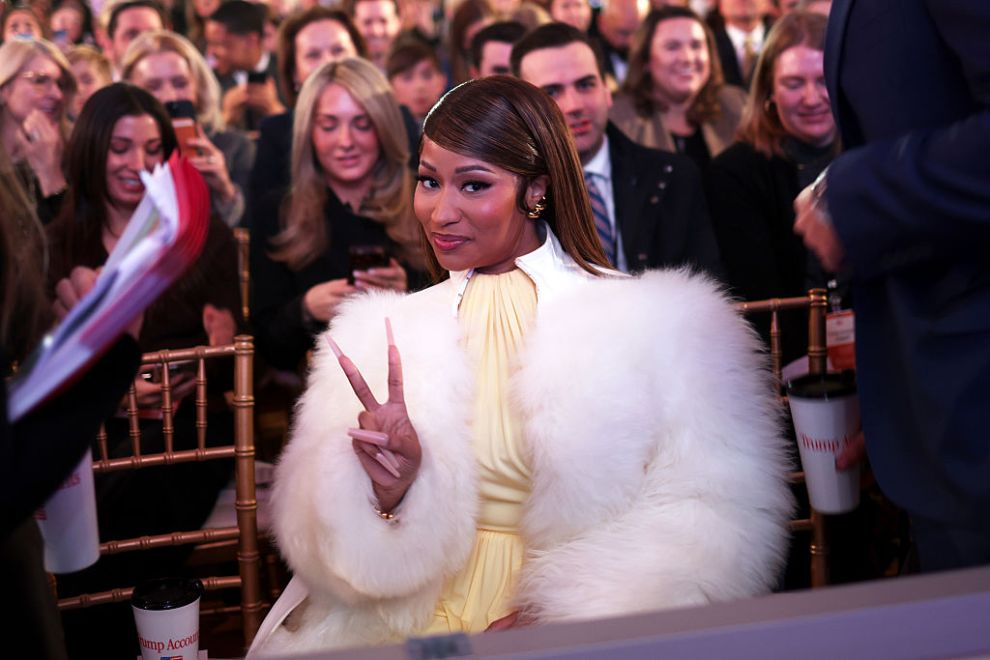
Nicki Minaj turned to social media this week to urge her supporters to contact their senators about the SAVE Act, a federal election bill that recently passed the House of Representatives. Her message followed a post from Elon Musk, who wrote, “Please call your senator and ask for voter ID to be passed.” Minaj echoed that call directly to her fan base, known as the Barbz, blending civic engagement with her signature online style. The posts quickly spread across platforms.
“Barbz, get your pretty little fingers out & call your senators. I’ll bribe you if I have to. 💕🎀” she wrote. She followed that with another message: “Dear Barbz, call your senators, then tweet #SaveAct to let me know you did it. Here’s a little video as a bribe to get you to do it. 😀 If you all do it, I’ll let you choose between a new look & [X] Spaces. The choice is yours. 🎀” Alongside the post was a brief video of Minaj walking down a hallway in a gray tracksuit, white sneakers and a fur coat. The approach was playful, but the subject matter was serious.
Later, Minaj expanded on her position by referencing earlier public health policies. “Test your pattern recognition skills. The ppl who told you to get that vaccine, and to get a thousand boosters, and to show proof everywhere you went that you had been vaccinated—are now telling you that people should NOT show ID to VOTE Haha,” she wrote. She concluded with, “Dear God, help US #SaveAct.” The remarks align with skepticism she has expressed in the past regarding vaccine mandates.
The SAVE (Safeguard American Voter Eligibility) America Act would require individuals to provide proof of U.S. citizenship and photo identification when registering to vote. The legislation would also revise certain mail-in voting procedures, according to ABC News. The House approved the latest version of the bill by a narrow 218-213 margin. It now moves to the Senate, where its prospects remain uncertain.
Clash Over Election Security and Voter Access
Supporters of the proposal argue that clearer identification standards could strengthen public confidence in elections. President Donald Trump recently wrote on Truth Social, “America’s Elections are Rigged, Stolen, and a Laughingstock all over the World. We are either going to fix them, or we won’t have a Country any longer.” Advocates of the measure say it is designed to ensure eligibility requirements are consistently enforced.
Opponents, however, caution that stricter documentation rules could create difficulties for some eligible voters, particularly those without easy access to updated government-issued identification. Representative Mike Thomson said, “The SAVE Act would make it harder for registered, legal voters to vote.” Senate Minority Leader Chuck Schumer previously stated, “The Republicans’ SAVE Act reads more like a how-to guide for voter suppression. It goes against the very foundations of our democracy. Mark my words: This will not pass the Senate.” Critics argue that existing safeguards already address concerns about election integrity.
Across the country, voter identification rules vary. Thirty-six states require some form of ID, while others rely on alternative verification methods. Election experts have said instances of noncitizen voting are rare, though debates over election access and security continue. As the bill heads to the Senate, lawmakers on both sides are expected to weigh concerns about participation, fairness, and trust in the electoral system.
Leave a Reply