
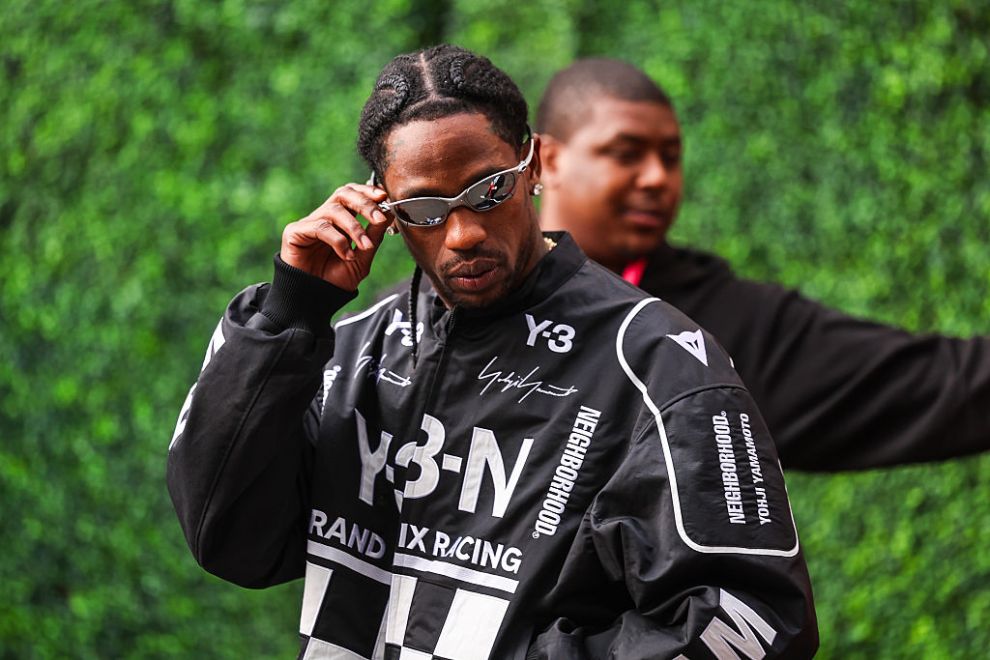
Travis Scott has stepped into a constitutional debate unfolding before the United States Supreme Court. He is lending his voice to concerns about how rap lyrics are used in criminal trials. Through his legal team, the Houston rapper submitted a filing supporting James Garfield Broadnax. Broadnax is a Texas man sentenced to death after being convicted of a double homicide near Garland in 2009. The case now raises broader questions about whether artistic expression can be presented as evidence of criminal character. Additionally, attorneys involved in the brief argue that the practice risks undermining basic First Amendment protections.
The filing focuses on the sentencing phase of Broadnax’s trial, where prosecutors introduced rap lyrics he had written. According to the brief, those lyrics were shown to a jury that was nearly entirely white. This shaped how the defendant was portrayed. “The manner in which prosecutors presented rap lyrics written by petitioner James Garfield Broadnax, a Black man, to an almost all-white jury during his capital sentencing hearing presents an ideal vehicle for addressing this issue because the prosecutors’ conduct here was particularly egregious,” the document states.
Scott’s legal team argues that the prosecution treated the lyrics not as creative work but as evidence suggesting future violence. In the brief, attorneys contend the argument implied that participation in “gangster rap” signaled a likelihood of criminal behavior. “The prosecutors argued Mr. Broadnax was likely to be dangerous in the future simply because he engaged in ‘gangster rap,’” the filing explains. “Such an argument functionally operates as a categorical and straightforwardly unconstitutional content-based penalty on rap music as a form of expression.”
The document also emphasizes that rap lyrics fall squarely under First Amendment protections. It notes that the genre, often created by minority artists, has frequently faced heightened scrutiny from law enforcement and prosecutors. As an example, the filing references reporting on the New York Police Department’s former unit informally known as the “hip-hop police.” This unit monitored rap culture and artists.
Rap Lyrics on Trial
Scott is not alone in supporting the appeal. Several artists and scholars have filed additional briefs raising similar concerns about the legal treatment of rap lyrics. Young Thug, T.I., and Killer Mike are among those who have publicly backed arguments that creative expression should not be interpreted as literal confession.
One supporting brief highlights another aspect of Broadnax’s trial that critics say is troubling. The lyrics were not introduced during the phase determining guilt. Instead, prosecutors presented them during sentencing to depict Broadnax as someone living a “gangster” lifestyle. This, they argued, meant he would remain a danger to society.
The case arrives amid a broader conversation about how courts interpret artistic work. Critics argue that rap lyrics are often treated as autobiographical statements. In contrast, violent imagery in other genres rarely receives the same legal scrutiny. The debate intensified during the YSL RICO case involving Young Thug in Georgia. At that time, artists including Drake, Megan Thee Stallion, and Post Malone backed a public campaign urging lawmakers to “Protect Black Art.”
Leave a Reply