
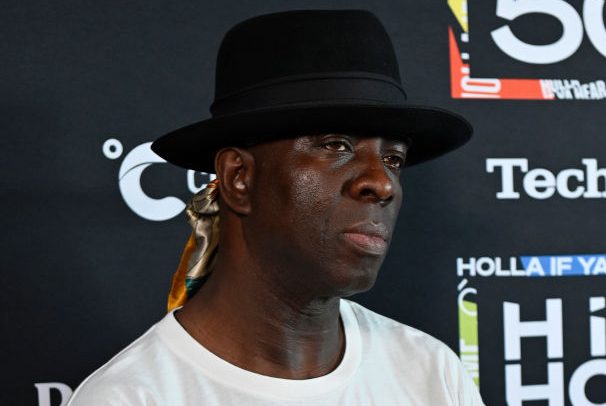
The hip-hop world is mourning the loss of Damien “E-Love” Matthias, a behind-the-scenes architect whose image helped define rap’s political imagination.
For decades, his silhouette stood frozen inside the crosshairs of Public Enemy’s iconic logo, one of the most recognizable symbols in music history. The image became shorthand for confrontation, resistance, and Black truth-telling in an era when hip-hop demanded to be heard.
Public Enemy confirmed E-Love’s passing on Friday through a tribute shared on Facebook. “Rest in power to our brother, @ELOVEGLOBAL,” the group wrote. “The man in the logo drawn by @MrChuckD almost four decades ago.” The message acknowledged his central place in the group’s legacy and the culture they helped reshape.
The logo has often been misunderstood. Some assumed the figure represented a police officer because of the hat.
In reality, the silhouette came from a photograph of E-Love standing next to LL Cool J. Chuck D, who studied graphic design, later adapted the image by hand in the mid-1980s. Set inside gun-sight crosshairs, it reflected surveillance, state power, and the vulnerability of Black life.
Hip-Hop Mourns LL Cool J’s Hype Man & Public Enemy Affiliate Damien “E-Love” Matthias Dies At 58
Chuck D has long described the image as representing “the Black man in America.” That meaning anchored Public Enemy’s identity as a political force and reinforced their self-styled role as a “black CNN,” reporting realities ignored by mainstream media.
E-Love’s impact stretched far beyond symbolism. He was a multi-platinum writer, producer, and director credited with contributing to more than 35 million records sold. His fingerprints appear throughout Def Jam’s rise, especially through his close relationship with LL Cool J.
E-Love co-produced LL’s groundbreaking debut album, Radio, and later helped amplify his crossover success. He also co-produced the video for “I’m Goin’ Back to Cali” alongside Rick Rubin.
He also helped clear paths for future icons, including Tupac Shakur and John Forte of the Fugees. In 1989, E-Love survived a near-fatal shooting in Queens, later reinventing himself through film and production.
His journey mirrored hip-hop’s own growth, marked by resilience, reinvention, and enduring influence.
Leave a Reply